The last few decades have brought an interesting challenge for business software vendors. In the past, a company would implement an ERP system and not think much beyond that. Today, however, the needs are far broader:
- Analyze data intelligently to make better decisions
- Sell products or services electronically through e-commerce
- Track commercial opportunities and customer relationships (CRM)
For each of these needs, highly specialized products exist. The problem arises when they coexist without integrating.
The modern digital ecosystem of a business
Today a mid-sized company might be simultaneously using:
In many cases this results in environments where different products share users, data and processes — but without true integration between them.
The real problem: data silos
If we add the fact that a large amount of information circulates electronically through emails, PDFs and spreadsheets without connecting to the central system, it becomes clear that the challenge today is not a lack of tools — it's integration between them. Data silos generate inconsistencies, duplications and poorly informed decisions.
Questions your ERP should be able to answer
Before evaluating additional tools, it's worth asking whether your current system can answer these questions:
- Can it automatically exchange information with my e-commerce platform?
- Can it read information from an email, a web page or a PDF without manual intervention?
- Can I embed web content or dashboards within the same system?
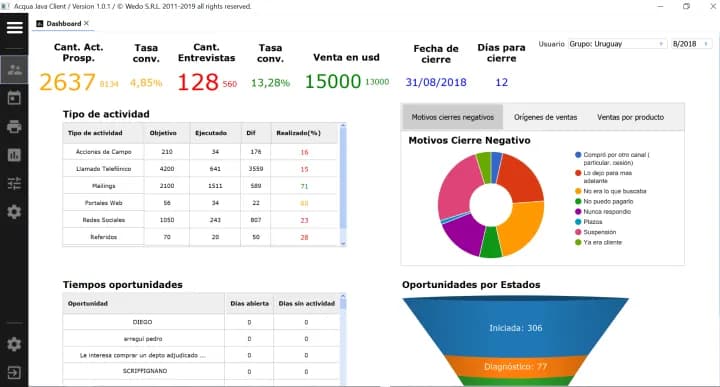
- Can I analyze operational data with charts and dashboards without exporting to Excel?
- Can the system receive external orders without an operator entering them manually?
If the answer to several of these questions is "no" or "with difficulty," you're paying the cost of technological fragmentation.
How ACQUA ERP solves the integration challenge
ACQUA ERP is one of the few products that offers enough flexibility to resolve this type of need without major friction, and in particular offers several options for data analysis.
Integrated data analytics: OLAP + Metabase
In its standard distribution, ACQUA ERP includes:
OLAP technology through Saiku — enables multidimensional analysis of system data, navigating across different dimensions (time, branch, product, customer) through an intuitive visual interface.
Metabase integration — a tool that allows the development of custom dashboards, charts and ad-hoc analysis. Both products are commercially free and enable a meaningful level of analysis for business decision-making.
Neither Saiku nor Metabase require programming knowledge to use. An operations manager or executive can build their own dashboards in hours, not weeks.
E-commerce integration
ACQUA ERP integrates with the leading e-commerce platforms on the market — including Mercado Libre and Tienda Nube — allowing automatic synchronization of stock, prices and orders between the system and the online sales channel.
The equation that changes everything
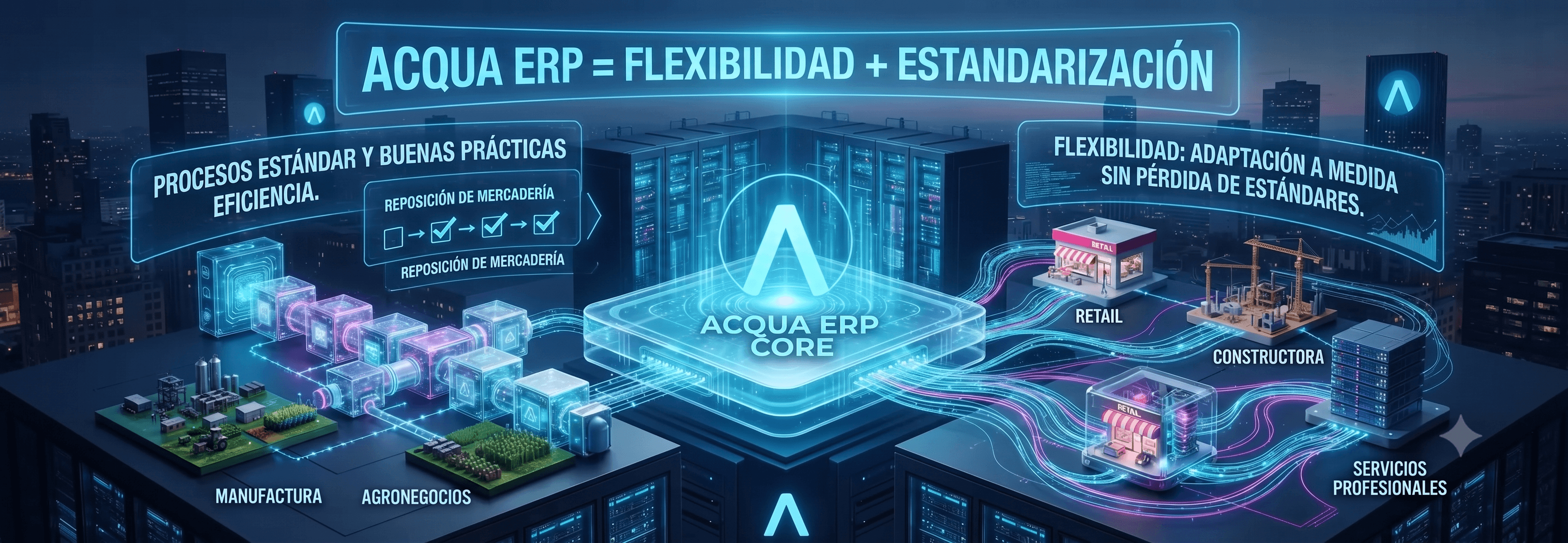
ACQUA ERP's proposition is not to replace all the specialized tools on the market. It's to be the integration core that connects operations with analytics and the sales channel, eliminating friction and duplicated data.
ACQUA ERP = Management + Analytics