Pursuing business goals, measuring growth, attracting good customers, having trained employees, meeting financial obligations, delivering projects on time, improving service, developing new products, innovating, seizing opportunities... In short, a lot of things to think about and work on.
And at the same time: neglecting any essential aspect can result in significant loss for the business.
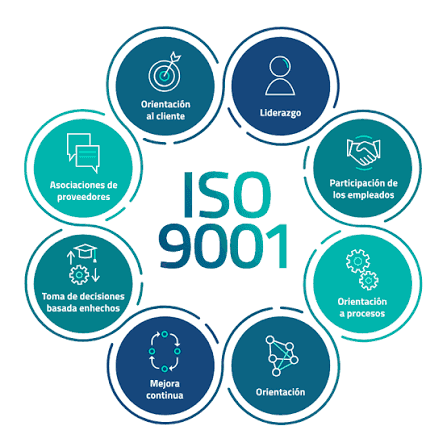
Is there a proven methodology that helps you grow, organize and improve? Yes. It's called ISO 9001.
The continuous improvement cycle
Several years ago, we began implementing the ISO 9001 standard at WEDO SRL. Today we are a certified company, and the process taught us something fundamental: many things started to fall into place on their own once we committed to the continuous improvement cycle.
"Identify improvement opportunities → plan → execute → evaluate" became part of our working philosophy and methodology. We now understand ISO 9001 as a business best practice applicable to any organization — and therefore potentially valuable for our clients.
This cycle, known as PDCA (Plan-Do-Check-Act), is not an abstract concept. It's a way of making decisions with data and avoiding repeating the same mistakes.
What does ISO 9001 cover?
The 9001 standard covers dimensions that in many companies are managed informally or simply ignored. Addressing them systematically is what makes the difference between growing with control and growing chaotically.
- Goals and performance indicators (KPIs)
- Documented procedures per process or department
- Stakeholder analysis (customers, suppliers, employees, regulators)
- SWOT analysis and business risk assessment
- Staff training records
- Job profiles and performance reviews
- Supplier evaluation and qualification
- Record of non-conformities and improvement opportunities
- Internal and external satisfaction surveys
- Communication plan, legal requirements and management review
Neglecting any of these aspects can lead to critical situations. Addressing all of them, on the other hand, brings predictability and generates trust among everyone who interacts with the organization.
From standard to system: the ACQUA QA module
Always aligned with our vision of technology at the service of management, we developed the Acqua QA module — a tool that simplifies the management of all these aspects within the same ERP.
What does the QA module solve?
The ACQUA ERP QA module allows you to:
- Record and track non-conformities detected in internal processes or reported by customers
- Manage improvement opportunities with responsible parties, deadlines and statuses
- Document corrective and preventive actions with full traceability
- Administer internal audits and prepare evidence for external audits
- Consult the complete history of incidents and their resolution from a single place
Why integrate it into the ERP instead of using a separate tool?
Because quality issues don't happen in a vacuum: they're connected to purchase orders, shipments, specific customers, production batches. Having quality management inside the same system where operations happen allows you to link each non-conformity to its real context — without exporting data or cross-referencing systems.
Conclusion: quality is not a certificate, it's a habit
ISO 9001 is not just a plaque to hang in the reception area. It's a commitment to consistency, to improvement, and to the trust we build with our customers, employees and suppliers.
At WEDO we live it ourselves. And that's why we developed the tools for our clients to live it too.